
5 Questions to Ask Before You Buy Laundromat Equipment
Get your laundromat equipment mix wrong, and it shows on your busiest days, with a growing line for one machine size, idle machines in another corner and customers who take their laundry somewhere else. It’s not a decision you make often, but you live with it every day after the install.
You don’t have to guess. Getting it right comes down to five things:
- Your customers and the laundry they bring
- Your laundromat’s floor space and utilities
- The choices you want to give customers at the machine
- The data you want to track
- Who will help you plan your equipment and layout
The good news is that operators who’ve been there found their answers on their own floors.
Why the Spec Sheet Is Only Part of the Story
A spec sheet tells you a lot about commercial laundry machines: capacity, extraction speed and which controls they run. What it doesn’t tell you is which machines your customers reach for most.
That’s true even for equipment pros. Zach Brewer is the general manager of Rhino Laundry & Dry Cleaning, a Huebsch® distributor in Salt Lake City. When he rebuilt and rebranded a run-down West Valley City, Utah laundromat as Big Wash, his Huebsch Command™ data showed the 100 lb. machines were the most popular size.
“The only time the 80 lb. washers were used was when the 100 lb. ones were already in use,” Brewer said.
Huebsch Vended Laundry Equipment at a Glance
- Huebsch washer options include hardmount washer-extractors from 20 lb. to 100 lb., softmounts from 20 lb. to 70 lb. and stacked washer-dryers.
- Huebsch dryer options include single-pocket and stacked tumble dryers.
- Depending on the model, Huebsch machines run on Galaxy™ Touch or Galaxy™ 600 controls, both coin and cashless payment capable.
5 Questions Worth Answering First
As you plan your equipment, start with these five questions. Each one helps match your machine mix to your customers, your space and how you want to run your store.
1. Who Walks Through Your Door, and What Are They Carrying?
Understanding your customers, and the laundry they bring each week, is the first step in planning your equipment mix. When Aaron and Andrea Milam bought The Laundry Room in Pasadena, California, they started with the neighborhood: a busy strip mall two blocks from Pasadena City College and close to Caltech.
Their distributor helped them build a mix of 38 Huebsch washers, from top loaders up to 60 lb. washer-extractors, plus 17 stacked tumble dryers so their business could meet the needs of the people in the surrounding neighborhood.
At Wash Co. in Middletown, New York, Glen Sheeley saw strong demand for big machines. His two 100 lb. and two 80 lb. washers stayed busy enough that he said he wished he had two more of each.
Your own customers shape your machine mix the same way. Students and single renters tend to bring smaller weekly loads while families bring larger loads with items like bedding and towels that need larger machines. Matching each laundromat washer and dryer to those loads is where a good mix starts.
2. How Much Room Do You Have to Work With?
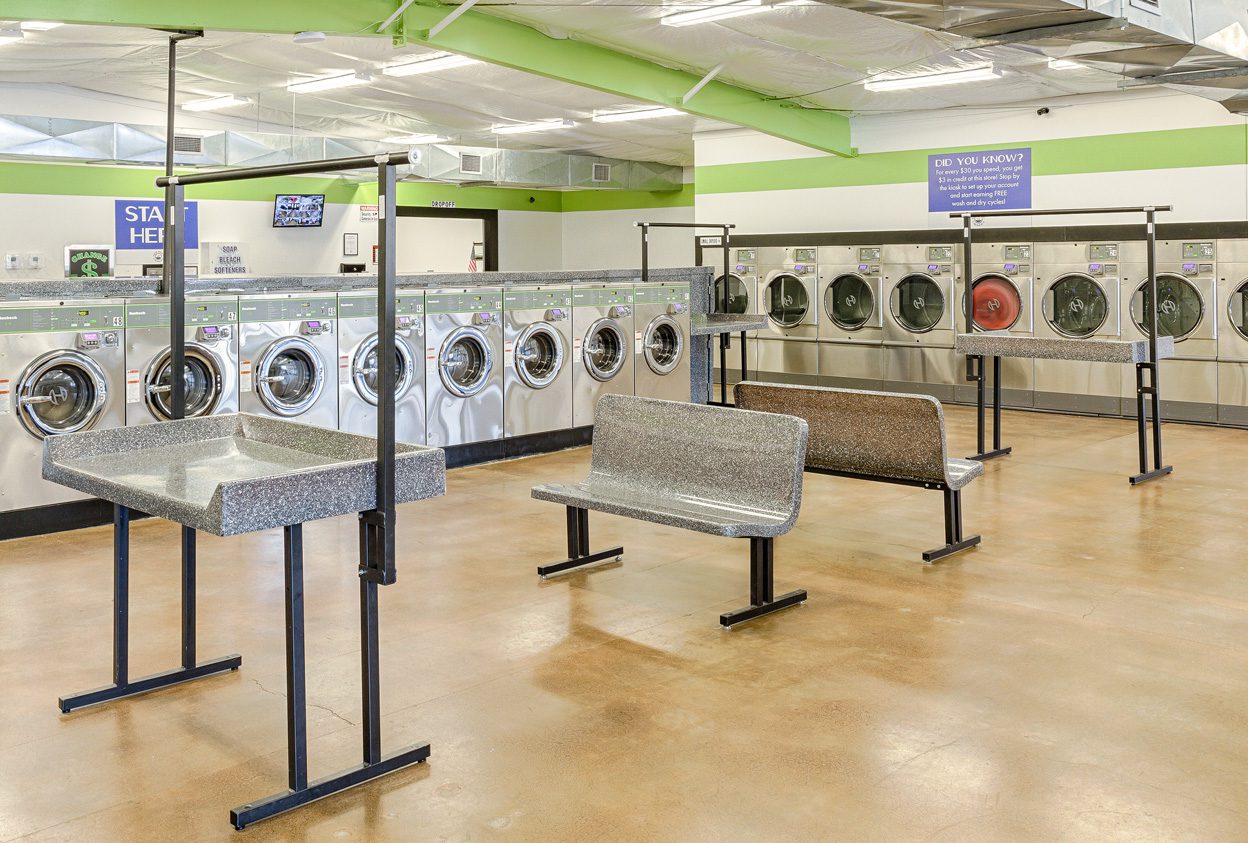
Choosing machines can be the fun part. But a floor packed edge to edge can leave customers feeling cramped. On the Laundry Nerd podcast, Kyle Pethke, Alliance Laundry Systems’ Manager of Laundry Design, discusses the shift toward larger machines along with a common layout mistake: overcrowding the floor.
When Mark Hickey moved his two Spin City stores in Tennessee and Mississippi into larger buildings, he planned for breathing room. “I wanted to model them after the trend of Southern gas stations,” Hickey said. The extra space lets customers spread out instead of working on top of each other.
Stacked washer-dryers and stacked tumble dryers put two machines in one footprint, which helps in narrow storefronts.
3. How Much Choice Do You Want to Give Customers at the Machine?
Some customers like to customize every wash. Others just want to pick a cycle and go. Your controls decide how much of that choice you can offer.
- More ways to customize: A full-color touchscreen like Galaxy Touch offers 12 programmable cycles and seven add-on options, like Extra Rinse, Heavy Soil and an Allergy Cycle, that you can price individually. At Big Wash, Brewer has said his customers like being able to build their own custom cycles.
- Straightforward choices: A control like Galaxy 600 keeps things simpler, with standard cycles and a familiar interface. It’s the control the Milams chose for their washer-extractors in Pasadena, and the one John and Ceara Templin chose for Laundry Lounge in Winslow, Maine. For many stores, fewer settings is the point.
Neither control is the “upgrade.” It comes down to how your customers wash and how much programming you want to manage.
4. What Do You Want to Know About Your Store When You’re Not There?
You can’t be at your store every hour it’s open. So what happens when you’re not there? One operator shared a late-night story on the Huebsch Command page. Their attendant called about an overloaded washer that wouldn’t spin out. Instead of driving back to the store, the operator’s husband logged into Huebsch Command from home, started the machine and advanced the cycle.
Remote access can save you that trip. A management platform like Huebsch Command connects the whole store, separate from the controls you choose. Depending on the package, you can check machine status, pull revenue reports, start machines remotely and give customers an app with rewards and live machine availability.
5. Who Will Help You Plan Your Equipment and Layout?
Knowing where to start can feel overwhelming, but you don’t have to figure it out alone. Laundry Lounge started with Ceara Templin’s offhand remark about their local laundromat, which got her husband, John, picturing a store built around comfort and function.
Their distributor, Tom Tobiassen of Daniels Equipment Co. in Auburn, New Hampshire, handled floor space planning and equipment recommendations, so John could focus on construction. “I didn’t have to worry about anything except signing paperwork,” he said.
New to the industry, Hickey leaned on distributor Mike Leake of Larry & Mike’s Laundry Services in Memphis, who taught him the business and helped him find both store locations.
That partnership is how Huebsch works. Through Huebsch Laundry Design, your distributor can also provide a site demographics report, a preliminary layout, a utility schedule and technical drawings.
Before Talking to Your Distributor
Whether you’re opening a new store or updating one you already run, a little homework helps your distributor make recommendations specific to your store and your customers:
- If you already run a store, note your busiest days and hours and which machine sizes have a line. If your machines report usage data, pull it.
- Measure your floor and note where drain, water, gas, electrical and exhaust connections sit today.
- Planning a new build or utility changes? Bring your distributor in before plans are final.
Find the Laundromat Equipment Mix That Fits Your Store
Every operator here answered these questions differently, so there’s no one right answer. Your local Huebsch distributor can help you work through yours.
Frequently Asked Questions
Can coin-laundry washing machines also take credit cards?
Many can. With Huebsch Command, you can add Scan-Pay-Wash, which lets customers scan a QR code and pay by credit card or Apple Pay in their phone's browser, no app required. The Payment Center adds a card reader at each machine.
Do I have to replace all my laundromat washers and dryers at once?
Not necessarily. Some operators start with their busiest or most-repaired machines and phase in the rest over time. Others replace everything during a remodel.
How much does laundromat equipment cost?
It depends on capacity, configuration and controls, plus installation and utility work like drains, bulkheads and gas or electrical hookups. Larger machines and touchscreen controls generally cost more. Your distributor can price a full mix, and our guide to what it costs to open a laundromat covers the bigger budget picture.